Appearance
Module 2: Architectural Constraints 架构约束
核心理念:不要告诉Agent"写好代码",用机制强制什么是好代码。
2.1 架构约束执行机制
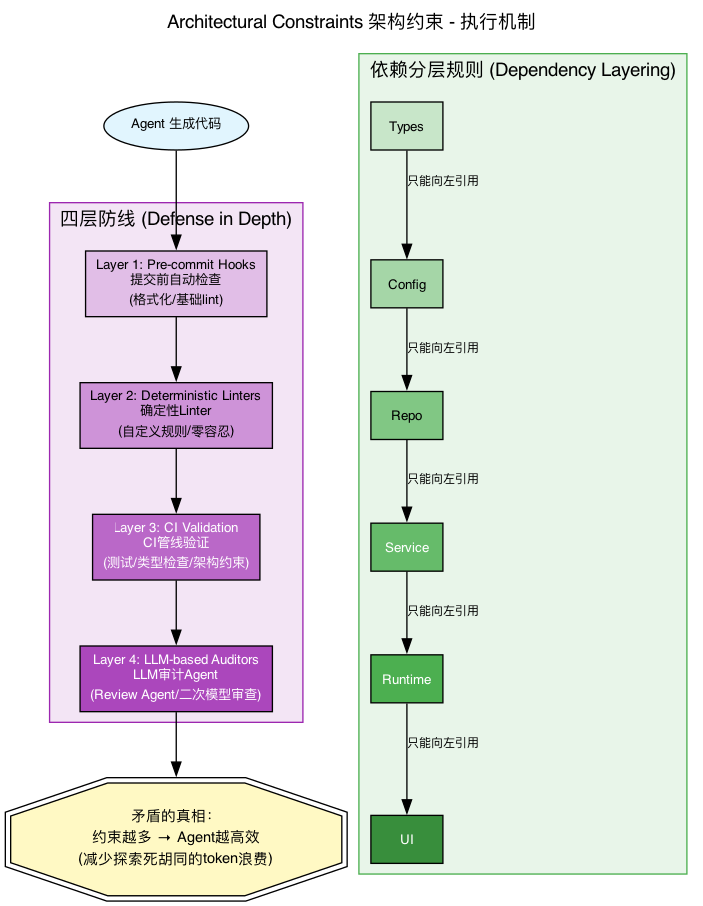
📐 查看Graphviz源码 (02-constraints-enforcement.dot)
dot
// 见 dots/02-constraints-enforcement.dot2.2 四层防线详解
Layer 1: Pre-commit Hooks
bash
# .pre-commit-config.yaml 示例
repos:
  - repo: https://github.com/pre-commit/pre-commit-hooks
    hooks:
      - id: trailing-whitespace
      - id: end-of-file-fixer
  - repo: https://github.com/astral-sh/ruff-pre-commit
    hooks:
      - id: ruff
        args: [--fix]
      - id: ruff-format
Layer 2: Deterministic Linters
规则比建议更强大:如果一类错误反复出现,停止描述它,开始预防它。
markdown
# 在AGENTS.md中定义编码标准
1. **YAGNI**: 不需要就不建
2. **DRY**: 第二次重复后再提取,不要过早
3. **Fail Fast**: 显式错误胜过静默失败
4. **Simple First**: 先写明显的解决方案
5. **Delete Aggressively**: 更少代码 = 更少Bug
6. **Semantic Naming**: 语义化命名,优化人和LLM的理解
Layer 3: CI Validation
yaml
# 架构约束的CI检查
- 依赖分层规则(Types → Config → Repo → Service → Runtime → UI)
- 每层只能引用左侧层
- 结构化测试(类似ArchUnit)
- 类型检查 (mypy/TypeScript strict)
Layer 4: LLM-based Auditors
用第二个模型审查第一个模型的输出:
- 高风险PR用不同模型交叉审查
- Review Agent专注于Agent代码的常见失败模式
2.3 Red Hat的两阶段约束工作流(实战方法论)
Red Hat工程师在Rust后端+TypeScript前端+Helm Charts的多仓库项目中总结出:"Vague In, Vague Out"是Agent最常见的失败根因。
解决方案:将约束分为规划阶段和实施阶段两道关卡。
Phase 1: Repository Impact Map(仓库影响地图)
在写任何代码前,让Agent用LSP和MCP扫描真实代码库,输出影响地图:
yaml
trustify (backend):
  changes:
    - Add CSV serialization for SBOM query results
    - Add GET /api/v2/sbom/export endpoint
trustify-ui (frontend):
  changes:
    - Add "Export CSV" button to SBOM list toolbar
关键:人类在此处审查。 如果Agent选错了模块、遗漏了仓库、或发明了不存在的endpoint模式,在这里拦截。成本:审查3行地图 vs. 审查100行PR。
Phase 2: Structured Task Template(结构化任务模板)
影响地图通过审查后,每个工作单元变成严格模板:
markdown
## Repository: trustify-backend
## Description
Add a CSV export endpoint for SBOM query results.
## Files to Modify
- `modules/sbom/src/service.rs` — add CSV serialization method
- `modules/sbom/src/endpoints.rs` — add GET handler
## Implementation Notes
Follow the existing JSON export pattern in `SbomService::export_json()`.
Reuse the `QueryResult` type from `modules/sbom/src/model.rs`.
## Acceptance Criteria
- [ ] GET /api/v2/sbom/export?format=csv returns valid CSV
- [ ] Existing JSON export still works
## Test Requirements
- [ ] Integration test in `modules/sbom/tests/` following existing test patterns
每个字段都有意义:
- Repository — 限定Agent在单个仓库内工作,避免跨仓库混乱
- Files to Modify — 真实路径(从Phase 1分析中得到,不是猜的)
- Implementation Notes — 引用真实的符号名和现有模式
- Acceptance Criteria — Agent可对照验证的清单
核心原则:Structure In, Structure Out. 你约束输入的结构越多,输出就越可预测。——Red Hat
2.4 为什么约束反而提升效率
矛盾的真相: 约束解空间越小,Agent越高效。
当Agent可以生成任何东西时 → 浪费token探索死胡同 当Harness定义清晰边界时 → 更快收敛到正确解
LangChain的证明: 同一模型,只改Harness中的约束 → 得分提升13.7个百分点
2.5 🔬 Lab 2: 构建约束体系
任务:
- 为Lab 1的项目添加
.pre-commit-config.yaml - 在AGENTS.md中添加明确的依赖分层规则
- 创建一个简单的CI检查脚本
- 故意让Agent违反规则,观察Harness如何拦截